he Brazilian men's basketball team earned its place at the Paris 2024 Olympics by turning a pressure-packed qualification tournament into a statement of intent. In Riga, Brazil defeated Montenegro and the Philippines before overpowering Latvia 94-69 in the final, securing an Olympic berth that had seemed increasingly difficult for a proud but inconsistent basketball nation. The Brazilian men's basketball team did not arrive in Latvia with the deepest roster or the loudest international profile. It arrived with a clear plan: defend aggressively, move the ball quickly and trust experienced players when the game tightened. That approach gave Brazil a place among the world's top teams again, even if the wider basketball conversation had moved toward the United States, France。Germany and Serbia.
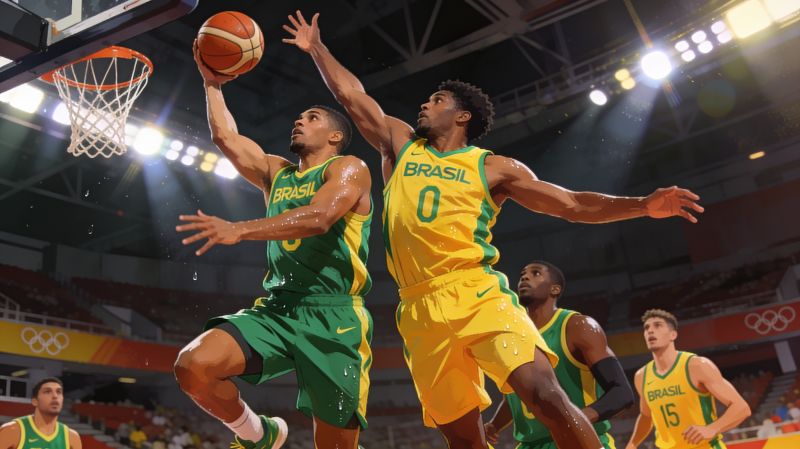
The Brazilian men's basketball team carried a blend of veteran leadership and emerging athleticism into Paris. Marcelinho Huertas, already one of the most respected point guards in Brazilian basketball history。remained the emotional center of the group at 41. His control of tempo was obvious in difficult possessions, when a hurried attack could easily become a turnover. Bruno Caboclo supplied scoring and length around the rim, while Gui Santos and other younger players provided energy on the wings. The Brazilian men's basketball team looked most dangerous when those pieces worked together rather than waiting for one star to solve every possession. That balance was visible during the Olympic campaign, particularly in the win over Japan, when Brazil produced a 102-84 victory through fast transitions and confident perimeter shooting.Paris also exposed the distance Brazil still has to cover. The Brazilian men's basketball team opened against Germany and lost 86-78, a game decided by Germany's stronger late-game execution and more reliable half-court offense. Brazil answered with its victory over Japan, but France then edged the South Americans 78-73 in a tense contest that featured several missed opportunities. The Brazilian men's basketball team advanced to the quarterfinals as one of the best third-place finishers。a result that reflected both resilience and the unusual strength of its group. Against the United States, however, the margin became unmistakable. Brazil fell 122-87 as the Americans punished defensive mistakes and turned nearly every loose ball into a fast-break chance. The score was harsh, but it did not erase the progress made in qualifying or the competitive spirit shown during the group stage.What makes the Brazilian men's basketball team compelling is the contrast between its history and its current reality. Brazil won Olympic bronze in 1948, 1960 and 1964, then added another bronze in 1968, while the national program produced celebrated figures such as Oscar Schmidt and Wlamir Marques. The modern Brazilian men's basketball team cannot simply rely on that legacy. Domestic development, player availability and the strength of the national league all shape its chances against Europe and North America. Coaches have increasingly emphasized defensive versatility, physical conditioning and a faster offensive rhythm, areas that can narrow the gap when Brazil faces taller opponents. From the sideline。
the team often looks more competitive when it embraces urgency instead of trying to imitate the polished systems of richer basketball powers.The next test for the Brazilian men's basketball team will be maintaining that urgency after the spotlight of the Olympics fades. A promising tournament can become a footnote if younger players do not receive meaningful roles and if the federation cannot build continuity around its veteran core. Huertas offered leadership in Paris, but Brazil needs another generation ready to control games, defend without fouling and make decisions under pressure. The Brazilian men's basketball team has the talent to remain a serious international presence。though talent alone will not produce medals. Its best route forward is practical rather than glamorous: keep developing guards, improve shooting consistency, protect the defensive identity and give emerging players responsibility before the next major tournament arrives. Brazil has already shown that it can return to the Olympic stage. The harder task is staying there and making opponents uncomfortable every time the green and yellow jerseys appear.